- 30 views
Rob Pountney’s landscape art is rooted in a lifelong fascination with the Wessex region of southern England and its rich tapestry of natural, historical and archaeological features. His work is also shaped by a deep engagement with Thomas Hardy’s verbal‑visual interpretations of the Wessex landscape — an interest that developed during his Fine Art studies and later through doctoral research in English Literature.
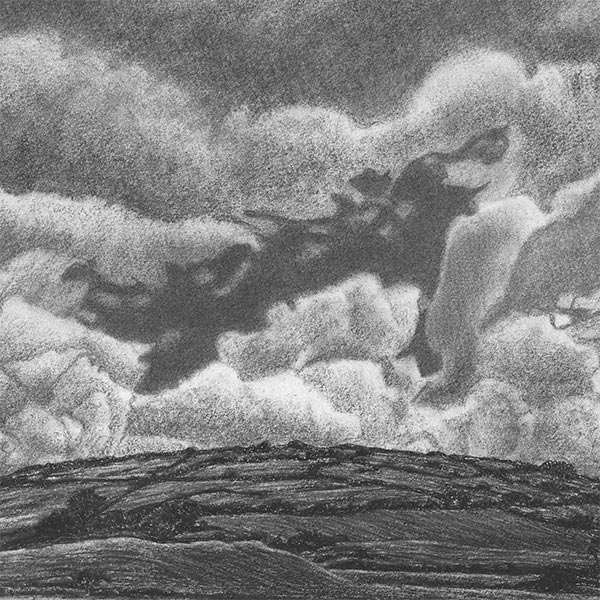
Much of his practice centres on the varied terrains of Dorset — its downlands, heaths, river valleys, earthworks and barrows — landscapes that speak of time and reveal visual paradoxes created by shifting perspectives between old and new, permanence and fragility, life and death. His predominant use of chiaroscuro heightens these tensions, dramatising the relationship between past and present, the visible and the unseen. Through contours, curves, lines, circles and angles, his drawings invite contemplation of the long sequence of natural and human events that have shaped these ancient places.
Rob has exhibited widely in both private and public galleries, with major solo exhibitions at Dorset County Museum (2000), Salisbury and South Wiltshire Museum (2004), and Wiltshire Museum (2007). His work was later shown in a touring group exhibition — Landscapes of Thomas Hardy’s Wessex (2011–2012) — alongside artists Dave Gunning and David Inshaw, reflecting a shared response to the antiquity and atmospheric presence of the Wessex landscape.
His drawings are held in public collections including Dorset County Museum, Wiltshire Museum, Yorkshire Arts Association and Bedfordshire Education Authority, as well as numerous private collections in the UK and abroad. His background in literature has also led to the publication of several articles in The Thomas Hardy Journal.
Rob’s work has been featured in regional newspapers, magazines, literary journals and on BBC regional television and online platforms, further establishing his reputation as an artist whose practice bridges visual art, landscape history and literary insight.