As its collection expands into the 20th century and beyond, the National Gallery stages its first exhibition of modern paintings from Germany – and its first devoted to an artistic movement after 1900.
Following its run in London in spring 2027, the exhibition will travel to the National Gallery of Ireland in Dublin and opens in Autumn 2027.
German Expressionism: Modern Painting 1900-1918 is the first exhibition in the UK and Ireland since the 1960s to chart the work of both of the movement’s pivotal groups Die Brücke (The Bridge) and Der Blaue Reiter (The Blue Rider) – who were active from 1900 until the end of the First World War. Made up of radical, freethinking artists working across Berlin, Dresden, Munich and elsewhere, these collectives experimented with form and brushwork to break new ground in 20th-century painting.
With loans from some of Germany’s most prestigious modern art collections, such as Berlin’s Neue Nationalgalerie and Brücke Museum and the Museum für Kunst und Gewerbe, Hamburg, the exhibition explores an alternative history of Modernism, to the predominantly French focus of the National Gallery’s current post-1800 collection.
While the featured artists Wassily Kandinsky (1866-1944), Gabriele Münter (1877-1962), Franz Marc (1880-1916) and Ernst Ludwig Kirchner (1880-1938), worked across many media, the exhibition celebrates the remarkable achievements of these artists in painting – the electrifying colours, energetic brushstrokes, and formal fragmentation that opened the doors to Abstraction.
Working in parallel in different regions of Germany, Die Brücke and Der Blaue Reiter sought to free painting from naturalistic constraints and express an intensity of individual experience on the canvas.
Die Brücke was formed in Dresden by a group of young, self-taught artists including Kirchner, Erich Heckel (1883-1970) and Karl Schmidt-Rottluff (1884-1976). Rebelling against conservative social codes, they lived and worked together in the bohemian corners of Dresden before moving to Berlin’s rapidly modernising centre. Die Brücke painted with an eruptive emotional force; colour became a live current and a deliberate defiance of academic traditions and brushwork, a form of liberation.
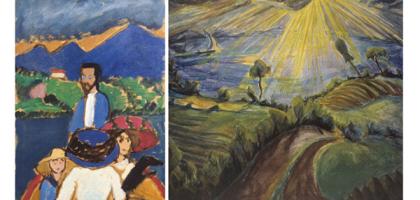
Der Blaue Reiter assembled in Munich around the close creative partnerships of painters Kandinsky and Münter, as well as Marianne von Werefkin (1860-1938) and Alexei Jawlensky (1864-1941). Kandinsky, Werefkin and Jawlensky were Russian émigrés drawn to Germany’s progressive art scene, where they cultivated a spiritual ethos of painterly expression. Joined by young artists like Marc and August Macke (1887-1914), they divided their time between metropolitan Munich and the luminous landscape around rural Murnau, where the lakes and mountains fed their bold, folkloric colours and semi-abstracted use of forms.
The outbreak of the First World War curbed the utopian ideals of Die Brücke and Der Blaue Reiter, as artists fled Germany or were drafted into the military. While their charged and distorted style ensured a strong legacy in 20th-century art, their work remains under-represented in British and Irish collections. German Expressionism: Modern Painting 1900-1918gathers over fifty international loans, rarely seen in the UK and Ireland, to give a comprehensive introduction to this transformative moment in modern painting.
Pictures come from private collections and museums worldwide including the National Gallery of Ireland; National Galleries of Scotland; Tate; The Art Institute of Chicago; Museum Wiesbaden; Kunstpalast Dusseldorf; Moderna Museet, Stockholm; Leicester Museum and Art Gallery; Von der Heydt Museum, Wuppertal; the Ashmolean Museum, Oxford; and Allen Memorial Art Museum.
Sean Rainbird, co-curator, says: ‘A critic first used the term ‘Expressionism’ before the First World War to describe modern painting from France and Germany. He also predicted the term would, in the future, be most closely associated with art from Germany. There were several pre-eminent individual Expressionist artists from Germany and Austria, but some of the best known belonged to two now-famous groups. This exhibition is the first time for many decades that both – called the Brücke and Blue Rider – have been combined for an exhibition in Britain and Ireland. It offers a unique opportunity for visitors to experience the artists' bold colours, formal innovations, spiritual aspirations and strength of individual expression, boldly extending the current parameters of the National Gallery’s displays into the early 20th century.’
Daniel F. Herrmann, co-curator, says: ‘The early 20th century became a crucible for new ways of seeing the world. Modern life brought the rise of modern painting, created by visionary artists who upended old rules with an urgency and defiance that still inspires painters today. Snuffed out by the First World War and rarely seen in Britain, German Expressionism was a daring chapter in the history of art. We can't wait to introduce this important moment in painting to our visitors in London and Dublin.’
Dr Caroline Campbell, Director of the National Gallery of Ireland, says: ‘We are delighted to embark on this new partnership with the National Gallery, London, as we work together to present a thoughtful exploration of German Expressionism across our islands. Our partnership offers an important opportunity to share our collections and expertise, broaden perspectives, and deepen public engagement with a dynamic artistic moment that resonates across the generations. We look forward to welcoming audiences to the exhibition and thank our colleagues in the Irish Government and UK Government for their support through the UK-Ireland Cultural Co-Operation Programme.’
The exhibition is at the National Gallery, London (20 March - 1 August 2027) and the National Gallery of Ireland (9 September 2027 - 9 January 2028).
Photo Credits:
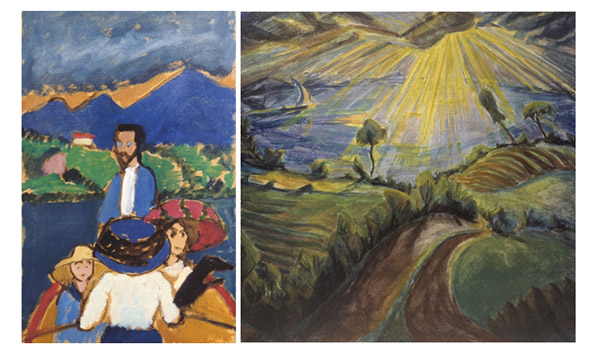
Gabriele Münter 1877-1962, Boat trip with Kandinsky, 1909, Private collection © 2026 DACS / Photo courtesy of the owner
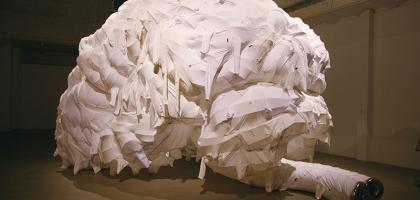
Erich Heckel 1883–1970, Spring, 1918, Neue Nationalgalerie Berlin (A II 307) © 2026 DACS / Photo Scala, Florence/bpk, Bildagentur für Kunst, Kultur und Geschichte, Berlin / Photo: Klaus Goeken
- 18 views