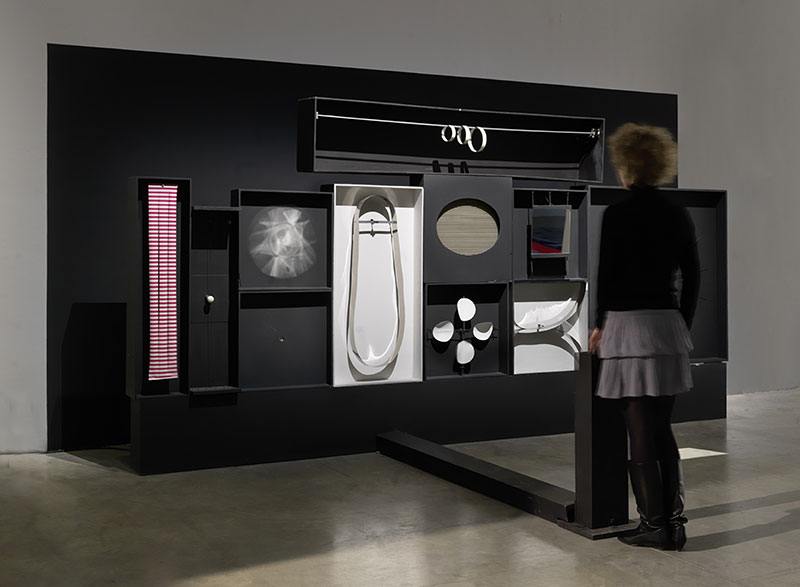
This summer, Tate Modern will stage an exhibition dedicated to the visionary work of Julio Le Parc (b. 1928). Organised in close collaboration with the artist and his Atelier, the exhibition will feature over 60 works spanning Le Parc’s extraordinary 70-year career, including interactive installations, striking light sculptures, and geometric abstract paintings. Arranged in a winding, maze-like manner, the exhibition will follow Le Parc’s career-long mission to activate the viewer, using optical effects, sensory experiences and physical interactions to make audiences aware of the role they can play in bringing art to life.
Born in Argentina, and studying at the Escuela de Bellas Artes in Buenos Aires, Le Parc moved to France in 1958 and joined the vibrant Parisian creative scene of the 1960s. The exhibition will open with the artist’s Surfaces series, early black and white gouache studies and paintings, created after his move to Paris in the late 1950s. These modular paintings use repeated geometric shapes and mathematical principles to create optical illusions, with as the patterns appearing to shift, rotate or flicker before the viewers’ eyes, as in Instability 1959 and Progressive Sequences 1959. Le Parc also experimented with the retinal afterimage, where high-contrast motifs leave a negative impression on the retina for long enough to be visible against a blank background, prompting the viewer to ‘complete’ the artwork with their eye movements.
Visitors will have the chance to engage with Le Parc’s well known innovative luminokinetic artworks. Initially emerging in 1959 as a series of Light Boxes - sculptures containing sheets of transparent acrylic plastic and light sources to create mesmerising sequences – these installations quickly evolved into Le Parc’s key body of work, the Continual Light Mobiles, debuted in 1960. Spotlights in combination with reflective or transparent moving elements create dynamic kaleidoscopic visuals which transform in front of the spectator. Continuous Light Mobile 1963 features suspended elements which move in response to the air flows generated by the viewers’ movements, further emphasising the importance of the audience in Le Parc’s practice. Light distortion effects are also explored in Unique Continual Light Cylinder 1962 as well as the room-sized installation Vibrating Light – Tulles 1968.
Other works invite deeper physical participation. 64 Reflective Blades 2017 encourages viewers to move between a painting and a screen with a row of reflective stainless-steel strips, fragmenting and distorting their reflection while making them part of the artwork itself. The exhibition will also display Le Parc’s Game Room installations such as Ensemble of Eleven Surprise Movements 1965, and Pattern to Manipulate 1967, which ask viewers to directly engage with artworks by pressing buttons, rotating elements and other acts of physical play.
The exhibition will conclude with Le Parc’s continued explorations of colour, ranging from his latest paintings to his earliest experiments. Much of Le Parc’s work utilises a signature palette of 14 hues, first developed in 1959 in works such as the Colour Project, a series of small gouaches in which Le Parc extrapolates every possible colour variation of his palette. Le Parc has continued to experiment with colour as well as black-and-white patterns throughout his career, notably in his iconic wave motif paintings such as Waves 125 Series 3 n°1 1972, and his later Modulations and Alchemies series. The striking Blue Sphere 2001-22, acquired by Tate in 2024, also demonstrates how Le Parc's recent sculptural work revisits and expands his earlier mobiles and kaleidoscopic light installations.
- 61 views