

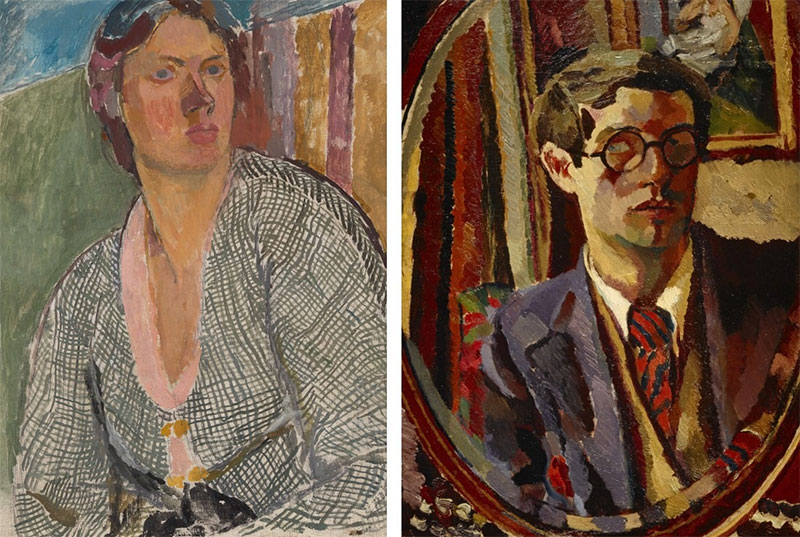
This autumn, Tate Britain will celebrate the extraordinary five-decade creative partnership between Vanessa Bell (1879-1961) and Duncan Grant (1885-1978), two of the most influential British artists of the 20th Century. Associated with the trailblazing Bloomsbury Group, Bell and Grant’s radical experimentation and unconventional approach to life reshaped art, literature and societal thought in Britain. Featuring over 300 works, Vanessa Bell & Duncan Grant: Inside Bloomsbury will be the first major exhibition to chart the duo’s relationship and artistic trajectory – from early post-impressionist and abstract paintings to late naturalistic self-portraits, landscapes, and still lifes. Demonstrating how they broke down the boundaries between art and everyday life, the show will bring together furniture, ceramics and textiles adorned with their modernist designs, as well as a once-in-a-lifetime restaging of the artists’ studio, relocated to Tate Britain from their East Sussex home, Charleston.
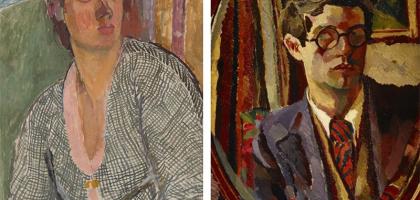
Although first introduced in 1906, it was a letter from Bell to Grant in 1909, inviting him to tea and proposing they address one another by their first names, that marked the beginning of an enduring, artistically fulfilling relationship. Portraits and self-portraits spanning Bell and Grant’s careers will chart both the course of their relationship and the evolution of their approach to artmaking. As core members of the Bloomsbury Group – a collective of artists, writers and intellectuals who discussed progressive ideas at 46 Gordon Square, the home of Bell and her siblings – both artists were at the forefront of avant-garde art in Britain. The exhibition will present works made before the pair met, to examine the formative experiences that shaped their radical art – from Bell’s instruction under John Singer Sargent which resulted in paintings like Iceland Poppies c.1908-9, to Grant’s encounter with historic masters in Paris, creating reproductions including After Chardin c.1906.
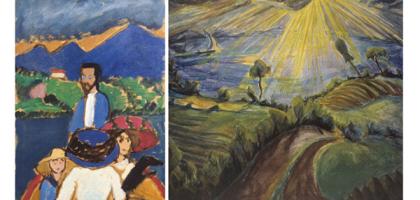
Viewing their works side-by-side, visitors will encounter their experiments with bold colour, simplified shapes and rhythmic lines, influenced by Roger Fry’s seminal exhibition ‘Manet and the Post-Impressionists’ in London in 1910. Their experimental works are exemplified by Bell’s Studland Beach c.1912 and Grant’s Group at Asheham 1913, which depict their circle of friends. Paintings made alongside one another of the same subject highlight a shared visual language, including Bell’s Still Life on Corner of a Mantelpiece 1914 and Grant’s The Mantelpiece 1914. Changing the face of British art with their radical modernist style, they pushed post-impressionist techniques to the limit and produced some of the earliest abstract works in the country.
Central to the dissemination of modernist ideas in Britain were the Omega Workshops, a design enterprise with a communal ethos. Established in 1913, the workshops blurred the distinction between fine and decorative art. Joining as directors, Bell and Grant created designs collaboratively alongside others which were applied to works including ceramics, fans, lampstands, chairs, tables and wardrobes. Further demonstrating how they translated their unique visual language across a range of materials and scales, Tate Britain will highlight their array of commissions, including Bell’s book cover designs for her sister Virginia Woolf and Grant’s murals depicting scenes of leisure in summertime. Representing the rare instances in which they worked towards a shared artistic output, commissions they made together will also be represented, including the landmark feminist work Famous Women Dinner Service 1932-34, comprising 50 hand-painted Wedgwood plates celebrating figures from Jane Austen to Cleopatra.
Though their partnership was predominantly creative, Bell and Grant shared a home for over 50 years and a daughter, Angelica. Favouring experimental ways of living, Bell had an open marriage with art critic and fellow Bloomsbury Group member, Clive Bell, while Grant had relationships predominantly with men. Although devoted to their domestic life together, insecurities arose from their nontraditional arrangement while Grant also experienced emotional conflict as a gay man in a society that did not accept him. The exhibition will showcase rarely seen erotic male nudes made by Grant, which remained hidden for many years, offering an insight into his life as a gay man.
Following the First World War, Bell and Grant returned to more naturalistic subjects, inspired in part by their travels across Europe. With a newfound sense of colour and form, they painted scenes along the Seine in Paris, and landscapes across the South of France, Italy and Spain. By the 1920s, they had settled into a stable, nontraditional family unit at Charleston in Sussex. The exhibition will present paintings conveying the serene life they experienced, marked by family, friends and art making, such as Bell’s Interior with the Artist’s Daughter c.1935-36 and Grant’s The Hammock 1921-23. For the very first time, the artists’ studio that they shared until 1939 will be relocated to Tate Britain while Charleston undergoes conservation work, offering a snapshot of the duo’s shared vision that continues to inspire generations, one in which art and everyday life are indivisible.
- 78 views